



Introduction: Helping Plants Perform Under Stress
Modern crop production is increasingly shaped by stress. Drought, heat, salinity, sudden temperature changes and other abiotic factors can disrupt plant metabolism, reduce nutrient uptake and negatively affect flowering, fruit set and as a result, the final yield.
For this reason, advanced plant nutrition is no longer only about providing nutrients to the plant metabolism. It is also about supporting plants utilize those nutrients more efficiently, induce their natural defense mechanisms and maintain physiological balance during critical growth stages.
This is where chitosan, and especially nano-chitosan, is gaining increasing attention in crop nutrition and biostimulation.
What Is Chitosan and Why Is It Important in Agriculture?
Chitosan is a natural biopolymer derived from chitin, a compound found in natural sources such as fungi, crustaceans and insects. In agriculture, chitosan is widely studied for its role as a biostimulant, elicitor and stress-response activator.
Unlike traditional nutrients, chitosan does not act simply by “feeding” the plant. Instead, it acts as a natural elicitor stimulating plant’s physiological responses that support quick adaptation and resilience under stress conditions. Research findings have linked chitosan with improved plant growth and protection responses under both biotic and abiotic stress, including beneficial effects on photosynthesis, germination, root development and plant defense mechanisms induction.
Abiotic Stress: A Silent Threat to Crop Performance
Abiotic stress often affects the crop before visible symptoms appear. When a plant is exposed to high temperatures, drought, salinity or cold stress, several physiological processes may be disrupted:
- photosynthetic activity decreases
- nutrient uptake becomes less efficient
- oxidative stress increases
- flowering and pollen viability may be affected
- fruit set and uniform fruit development may decline
Scientific literature shows that chitosan has been associated with improved plant resilience under stress conditions, including osmotic stress responses occurring in conditions of high salinity. It has also been studied for its role in supporting photosynthesis and reducing the impact of stress-related oxidative damage.
For crops such as olives, vines, citrus, fruit trees and vegetables, this makes chitosan especially relevant during sensitive stages of pre-flowering, flowering, fruit set and early fruit development.
Why Nano-Chitosan Makes the Difference
The form in which a biostimulant is delivered matters. Nano-chitosan allows the benefits of chitosan to be delivered in a more targeted and efficient way, thanks to its smaller particle size which results in higher surface area-to-volume ratio, as well as an increase in the surface area in contact with target cells.
In practical terms, nano-chitosan supports:
- faster interaction with the leaf surface
- increased biological activity
- higher defense induction at lower doses
- better support under abiotic stress conditions
Its role becomes even more valuable when combined with key nutrients -acting as a carrier due to its high encapsulating ability- involved in flowering, pollen quality, cell division, fruit set and stress tolerance.
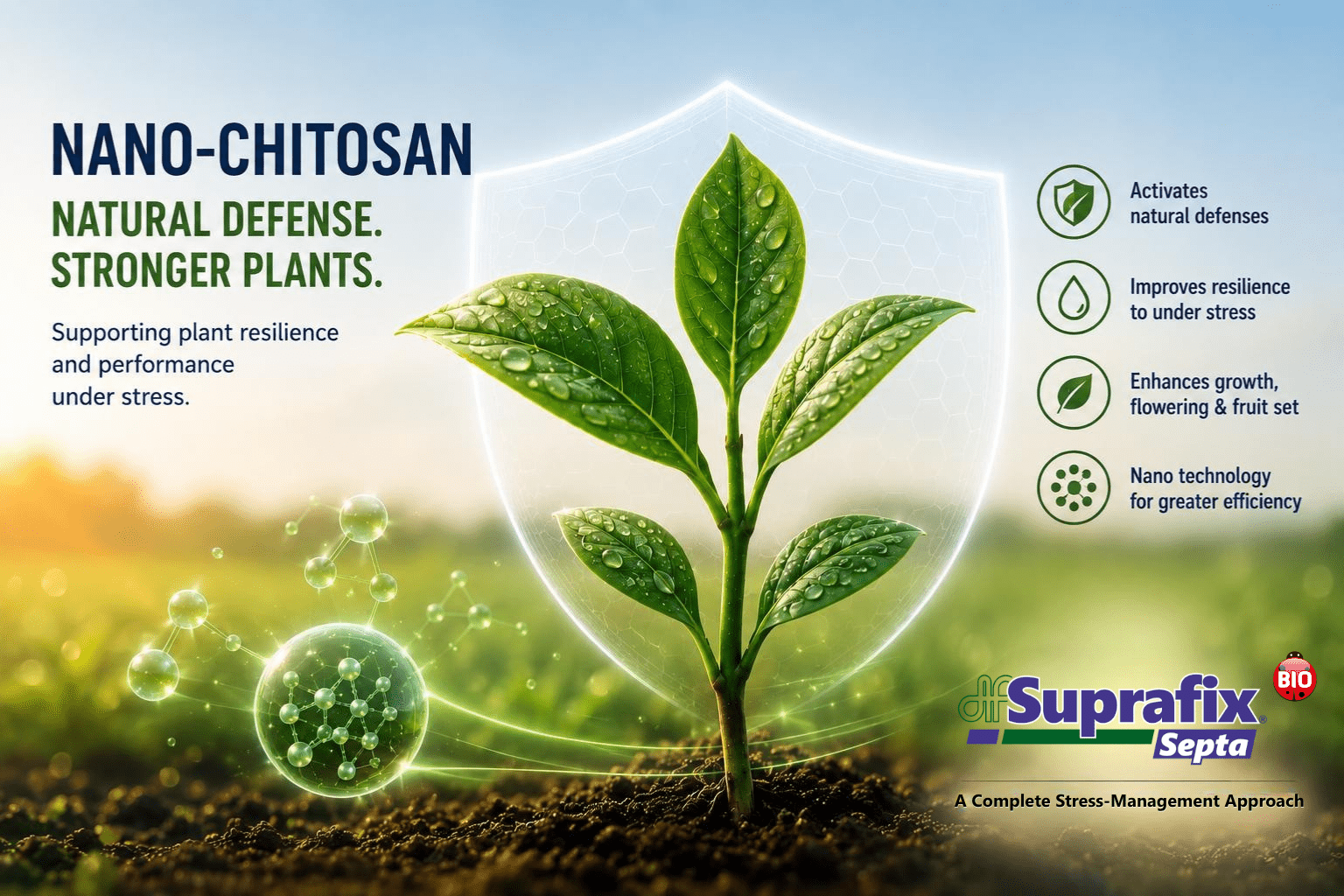
Suprafix® Septa SC: A Complete Stress-Management Approach
Suprafix® MoBoZin SC was developed around the powerful synergistic action of Molybdenum, Boron and Zinc — three elements directly involved in vegetative growth, flowering, pollen performance and fruit set.
Building on this nutritional concept, Suprafix® Septa SC was developed as a more advanced formulation, combining the Mo–B–Zn base with crucial for plant metabolism elements and bioactive components such as Silicium, supporting plant performance and productivity even under adverse stress conditions.
Suprafix® Septa SC composition
- Molybdenum (Mo): 0.6%
- Boron (B): 11%
- Zinc (Zn): 22%
- Calcium oxide (CaO): 3.2%
- Silicium dioxide (SiO₂): 2.2%
- Nano-Copper (Nano-Cu): 2%
- Nano-Chitosan: 0.5%

This seven-element composition is designed to support high-quality flowering, fruit setting and stress alleviation, while combining Nutrition, Biostimulation and Fortification of plant metabolism during critical growth stages, fully utilizing the effects of Agrology Functional Crop Nutrition® approach Suprafix® Septa SC is a formulation of Nano-Cu and Nano-Zn particles, fortified with bioavailable Silicium, Calcium, Boron, Molybdenum and Sulfur, enhanced with E²DA® Technology and it is suitable for both foliar application and fertigation.
The Role of Each Key Component
Boron (B): Flowering, Pollen Tube Growth and Fruit Set
Boron is essential for flowering quality, pollen tube development, cell division and fruit set. During reproductive stages, insufficient boron availability can directly affect fertilization and the uniform development of young fruits.
Zinc (Zn): Growth Regulation and Pollen Fertility
Zinc contributes to vegetative growth and hormonal balance, while also playing an important role in pollen fertility and early fruit development.
Molybdenum (Mo): Nitrogen Metabolism and Plant Efficiency
Molybdenum supports nitrogen metabolism, helping the plant use nitrogen more efficiently. This is especially important during periods of active growth and reproductive development.
Calcium (Ca): Tissue Strength and Physiological Stability
Calcium contributes to cell wall stability and tissue strength. Its role is particularly important in crops where fruit quality, firmness and physiological balance are key objectives.
Silicium (Si): Stress Tolerance and Structural Support
Bioavailable silicium supports the plant’s response to abiotic stress and contributes to stronger, more resilient tissues. In Agrology’s E-PerForm® framework, elemental biostimulants such as silicium are associated with stronger endogenous defense mechanisms, improved nutrient and water use efficiency, photosynthesis and crop quality.
Nano-Copper and Nano-Chitosan: Biostimulation and Stress Support
Nano-Cu contributes to the product’s functional profile utilizing both its antimicrobial and nutritional activity, while nano-chitosan acts as a bioactive component that supports the activation of natural defense responses. Together, they help position Suprafix® Septa SC not only as a nutritional product, but as a tool for crop support during stress-prone stages.
Three Agrology Technologies Working Together
Suprafix® Septa SC incorporates three advanced Agrology technologies: E-PerForm®, NanoFlow® and E²DA®.
E²DA® Technology: Enhanced Uptake and Movement
E2DA® Technology (Enhanced Elemental Delivery & Assimilation) was developed by AGROLOGY, to enhance the uptake and movement of nutrients within the plants. It is based on integrating a cocktail of organic factors with unique characteristics such as low molecular weight, absence of competition with metallic ions or high dissolvement within the plant tissues acting as carbon sources. products.
NanoFlow® Technology: Greater Absorption Through Nano-Sized Particles
The NanoFlow® Technology is a standardization technology of Nano-Suspensions developed by AGROLOGY, through which nano-particles of nutrients are incorporated into formulations of concentrated suspensions (SC). The nano-dimension of the particles of the nutrients exponentially increases their absorption and assimilation rate by the plant organism, optimizing the effectiveness of foliar feeding applications.
E-PerForm® Technology: Elemental Biostimulation
E-PerForm® Technology (Elemental Performance & Formulation Technology) is AGROLOGY‘s Hybrid Formulation and Performance Technology, which integrates Bio-available forms of Elemental Bio activators (EBA) and maximizes the performance of plant nutrition formulations..
When Suprafix® Septa SC Fits Best
Suprafix® Septa SC is particularly relevant during crop stages where the plant needs both nutritional precision and stress support, such as:
- pre-flowering
- flowering
- fruit set
- early fruit development
- periods before or after abiotic stress events
- conditions of high temperature, salinity, drought or cold stress
By combining Mo, B, Zn, Ca, Si, Nano-Cu and Nano-Chitosan with advanced formulation technologies, Suprafix® Septa SC helps support the plant during moments when performance depends on both nutrient availability and fast physiological response.
Conclusion: Chitosan as a Strategic Ally Against Stress
The hidden power of chitosan lies in its ability to help plants activate their own defense and adaptation mechanisms. In its nano-form, and when combined with key nutrients and advanced formulation technologies, it becomes a valuable tool for supporting crop performance under abiotic stress.
With Suprafix® Septa SC, Agrology brings together nutrition, nano-biostimulation, and in one formulation combined with advanced delivery technologies — helping crops maintain strength, flowering quality and fruit set potential when conditions become challenging.
For further information, please contact us at: global@agrology.eu
Contact us
Leave your details below and we will reach out to you with more information!